
Orange County has a branding problem, and it works in its favor. Say the name and people picture beaches and theme parks. What they should picture is one of the most quietly formidable business economies in America: a county of 3.2 million people whose economy would rank among mid-sized nations, where a single city (Irvine) anchors one of the world’s great medical device clusters, where a Costa Mesa defense technology company became one of the most valuable startups in the country, and where Newport Beach manages a meaningful slice of the planet’s bonds.
We provide managed IT and cybersecurity across Orange County, and this post is the view from that seat: what actually makes up this economy, where it is heading in 2026, and why the county’s specific mix of industries creates one of the most demanding IT and security environments in Southern California.
The 2026 outlook: growth without hiring
Start with the numbers, because they frame every business decision being made in the county right now.
Chapman University’s 48th annual economic forecast, the region’s institutional benchmark, projects US real GDP growth of 2.0 percent for 2026, up slightly from 1.8 percent in 2025, powered by record AI infrastructure investment and consumer spending backed by a $55 trillion rise in household wealth since 2020. Cal State Fullerton’s economists are more optimistic at 2.4 percent. But here is the local twist: Chapman projects Orange County job growth at roughly 0.3 percent, which is to say virtually flat, with California’s weak job growth expected to continue under tariff uncertainty and state tax pressures. Doti’s team put it plainly: no recession expected unless there is a major correction in AI, but hiring cools while the economy grows.
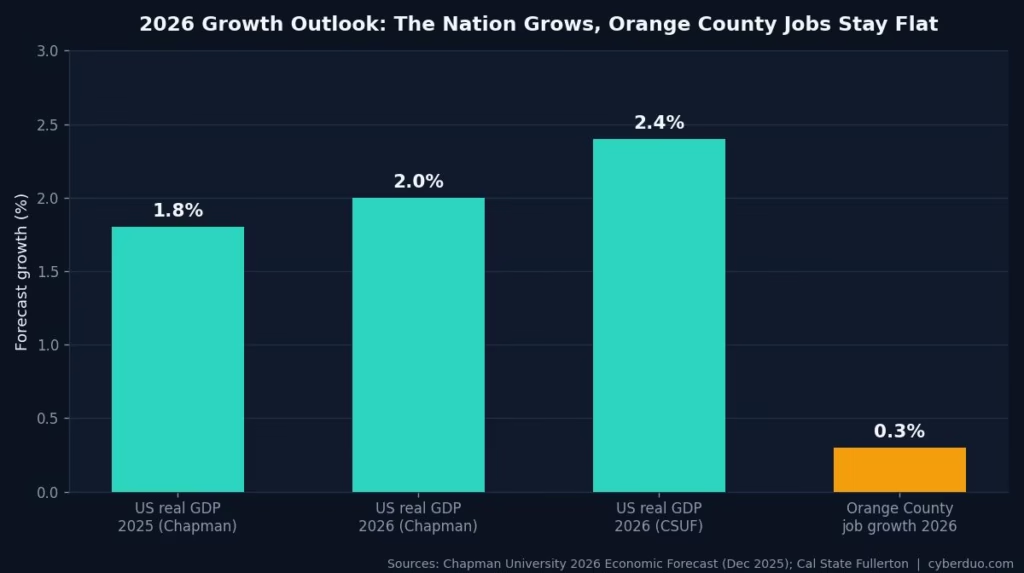
Read that chart the way an OC operator has to: revenue can grow in 2026, but headcount mostly will not. Companies here are being pushed to do more with the teams they already have, which is exactly the environment where technology decisions, automation, AI adoption, and outsourced specialist functions stop being nice-to-haves and become the growth plan. It is also, not coincidentally, the environment where lean companies get breached, because “everyone is stretched” is an attacker’s favorite weather.
There are tailwinds too. Mortgage rates are forecast to dip below 6 percent, which Chapman expects to revive housing activity, a meaningful lift for the county’s real estate, escrow, construction, and lending ecosystem. And the AI capex boom flows directly into OC’s technology and semiconductor firms.
What Orange County is actually made of
The county’s economy is not one thing. It is a set of dense, specialized clusters, and each one carries its own IT and security profile. These clusters are also, precisely, the companies we consider our ideal clients: 20 to 200 seat firms in regulated, IP-rich, or money-moving industries.
The Irvine medtech and life-sciences corridor. Orange County is one of the world’s leading medical device hubs, anchored by giants like Edwards Lifesciences and Masimo and surrounded by hundreds of smaller device makers, diagnostics firms, and suppliers. For every household name there are dozens of 30 to 150 person companies handling clinical data, FDA-regulated records, and IP worth more than their buildings. Their security stakes look a lot like the ones we described for biotech and life-sciences startups: the data is the company.
Aerospace and defense, old and new. The county’s aerospace heritage (Boeing’s Huntington Beach presence, decades of precision manufacturers and suppliers) has been joined by a new generation of defense technology, most visibly Anduril in Costa Mesa. Around these anchors sits a long tail of machine shops, component makers, and engineering firms in the defense supply chain, and for them the acronym that matters is CMMC. Department of Defense cybersecurity requirements now flow down to even small suppliers, and a shop that cannot demonstrate NIST 800-171 aligned controls is a shop that will lose contracts. This is some of the most consequential IT work in the county right now.
Newport Beach money. PIMCO alone makes Newport Beach a global fixed-income capital, and around it clusters a dense ecosystem of RIAs, family offices, private equity firms, and wealth managers, along with the county’s title and mortgage heavyweights in Santa Ana. These firms live under SEC scrutiny, cyber insurance interrogations, and the daily reality that they move life-changing sums by email, the exact behavior that made business email compromise a multi-billion dollar crime.
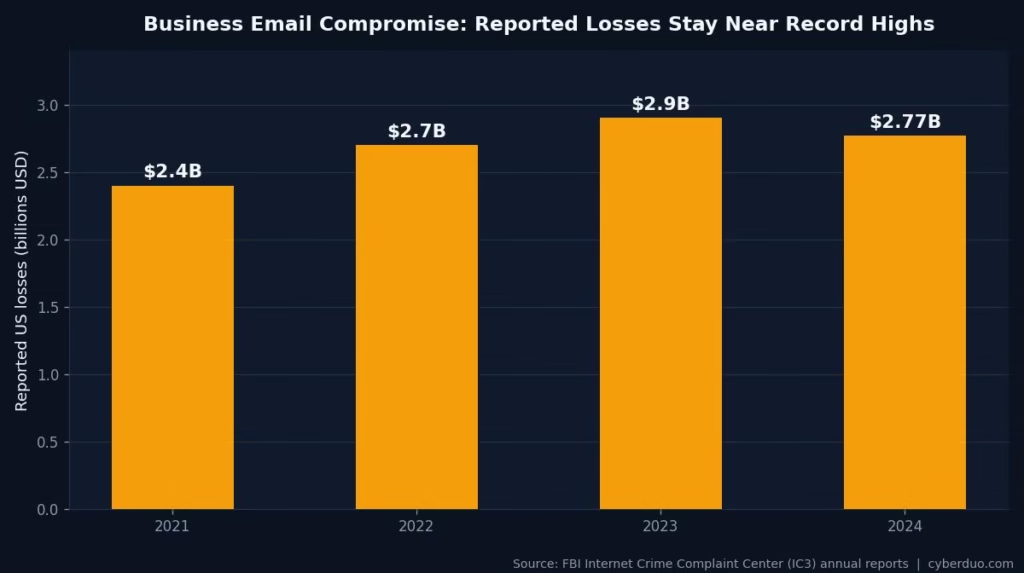
That chart is national, but its center of gravity is places like coastal Orange County, where high-value wires are routine and California consistently reports the highest BEC losses of any state.
Healthcare at scale. Hoag, Providence, UCI Health, and Kaiser anchor a healthcare economy that employs enormous numbers of people, and around the hospital systems orbit thousands of private practices, surgery centers, dental groups, and behavioral health providers. Every one of them is a HIPAA-covered entity holding exactly the records that sell highest on the dark web, and most of them are small businesses with no security staff. This is the profile we built our healthcare IT practice around.
Professional services everywhere. Irvine’s office towers and Newport Center fill with law firms, accounting practices, and consultancies, from regional offices of national firms down to boutique practices. Law firms in particular concentrate three risks at once: privileged client data, trust accounts that move money, and reputations that do not survive a public breach.
And the long tail. Tourism and hospitality around the Anaheim resort district, the action-sports and apparel brands of Costa Mesa and Huntington Beach, logistics, construction, and the thousands of ordinary companies that make a 3.2 million person county run. The overwhelming majority of Orange County’s employer businesses are small and midsize, which means the county’s real IT landscape is not the Fortune 500 towers, it is tens of thousands of 20 to 200 person companies making enterprise-grade security decisions with small-business budgets.
The Orange County IT environment, honestly assessed
Put the clusters together and a picture emerges that we see confirmed every week in the field.
The demand side is intense: regulated data everywhere (HIPAA, SEC, CMMC, and cyber insurance carriers acting as de facto regulators), high-value wire activity, world-class IP inside modest-sized companies, and a 2026 mandate to grow without hiring, which pushes everything into the cloud, into Microsoft 365, and increasingly into AI tools.
The supply side has not kept up. Most OC companies in that 20 to 200 seat band run one of three models: a single overwhelmed IT person, a generalist IT vendor whose “security” is antivirus and patching, or nothing formal at all. Meanwhile the threat side has industrialized, as we detailed in our tour of the stolen-data economy, and insurance carriers have responded by demanding real controls as a condition of coverage. The gap between what OC companies hold and how they protect it is the defining IT story of this market.
How we fit into this county
CyberDuo has served Orange County businesses for years as a cybersecurity-first managed IT provider, which in practice means the county’s risk profile is our home turf. For the medtech firm, that is protecting research data and regulated records with monitored, documented controls. For the defense supplier, it is aligning environments to CMMC and NIST 800-171 on the technical side so contracts stay winnable. For the Newport Beach advisory firm, it is hardened Microsoft 365, wire-fraud defenses, and the evidence trail that satisfies both the SEC examiner and the insurance application. For the medical practice, it is HIPAA-aware IT that keeps patient data guarded without slowing the front desk. And behind every client, regardless of industry, sits our own in-house 24/7 Security Operations Center, because this county’s attackers do not keep business hours and neither do we.
The bottom line for OC business owners
Orange County heads into 2026 with a strange and specific challenge: a growing economy, a frozen job market, and a threat landscape that has never been more professional. The companies that will win here are the ones that turn that squeeze into an advantage, using technology to grow without headcount while refusing to let “lean” mean “exposed.”
If you run one of those companies, our Orange County managed IT services page shows what we deliver locally, and we are always glad to talk specifics: your industry, your compliance obligations, your actual risk. This is our market, and we know it street by street.